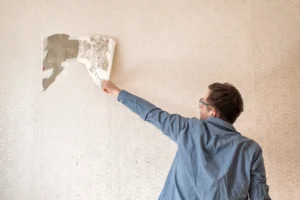
Knowing how to repair plasterboard saves you money and keeps your walls looking sharp. Holes from door handles, furniture, picture hooks and old fittings are common in every home. Cracks appear as buildings move. The good news is that most damage is easy to fix with basic tools and a little patience. This guide covers every type of repair, plus the signs that it is time to call a professional.
Types of Plasterboard Damage
The right repair depends on the size and cause of the damage. Look closely before you start.
Small dents and nail holes need only filler. Medium holes, such as those made by a door handle or a fist, need a patch. Large holes, often from removed fittings or accidents, need a cut-out repair with support behind. Cracks usually run along joints or around door and window corners. Water-damaged areas feel soft, stained or crumbly and need more careful treatment.
Tools and Materials You Need
Gather your kit first. A good set of tools makes the repair neater and faster. You will need:
- A utility knife and a plasterboard or keyhole saw
- A filling knife and a wider taping knife
- Ready-mixed joint filler or lightweight filler
- Self-adhesive mesh patches or jointing tape
- A plasterboard offcut of the same thickness, for larger holes
- Timber battens and plasterboard screws
- Sandpaper in medium and fine grades, plus a sanding block
- Primer, paint, a brush or roller, and dust sheets
- A dust mask, safety glasses and a vacuum
Buy quality filler and tape. Cheap products shrink and crack, which means you repeat the job.
Before You Start: Safety Checks
Safety comes first. Before you cut into any wall, check for hidden cables and pipes. Use a detector if you have one, and switch off power to nearby circuits. Never cut near wiring or plumbing without checking.
Older buildings need extra care. Textured coatings and some old boards in homes built before the year two thousand may contain asbestos. Do not sand, drill or cut materials you suspect contain it. The Health and Safety Executive asbestos guidance explains how to spot the risk and what to do. If in doubt, stop and ask a professional.
Finally, find the cause of the damage. A hole from an impact is simple. A stain, a bulge or a soft patch points to damp, and the source must be fixed first.
How to Repair Plasterboard: Step by Step
Choose the method that matches the damage. Each approach builds on the same basic skills: cut clean, fix firmly, fill smoothly and finish neatly.
Small Dents and Nail Holes
Scrape away loose material and wipe off dust. Press filler into the hole with a filling knife and smooth it level. Leave a slight bump, because filler shrinks as it dries. Once dry, sand it flush with fine paper and wipe the dust away. Deeper dents may need a second layer. This is the quickest fix and needs no patch.
Patch a Hole in Plasterboard: Medium Holes
To patch a hole in plasterboard up to a hand’s width, trim ragged edges with a knife. Clean the area and remove loose paper. Press a self-adhesive mesh patch over the hole so it overlaps the sound board on every side.
Next, spread a thin layer of joint filler over the patch with a wide knife, and feather the edges into the wall. Let it dry fully. Apply a second, wider coat to hide the patch edge, then a final thin coat if needed. Sand smooth between coats, and finish with fine paper.
Large Holes: Cut-Out Patch with Battens
For bigger holes, cut the damaged area into a neat square or rectangle with a saw or knife. Check behind the wall for cables and pipes first. Fix timber battens inside the opening, set slightly back from the edge, and screw them to the wall or to existing studs so they hold firmly.
Cut a plasterboard piece to fit the opening, and screw it to the battens. Tape the joints with jointing tape and cover with joint filler. Apply thin coats, feather the edges and allow each coat to dry before sanding. This method takes longer but gives a strong, flat result.
Finishing: Fill, Sand, Prime and Paint
Repairs only disappear when finished well. Sand the final coat smooth and vacuum away all dust. Then apply primer or a mist coat over the repair. Filler absorbs paint differently from plasterboard, so skipping primer leaves a dull patch that shows through. Finally, repaint the whole wall, or at least from corner to corner, so colours match. Good preparation makes the finish look seamless.
Plasterboard Crack Repair
Cracks appear for several reasons. Buildings settle and move, joints between boards open, and humidity changes make materials expand and shrink. Vibrations from traffic or building work can also cause cracks in London homes.
For reliable plasterboard crack repair, scrape out loose filler and widen the crack slightly with a knife, so filler grips. Remove dust. Bed jointing tape or mesh over the crack, then cover it with joint filler and feather the edges. Let it dry, sand lightly and apply a second coat. Prime and paint to finish.
If the crack is wide, grows quickly or runs across several walls, stop. It may point to structural movement that needs expert advice. Filler will not cure movement, and the crack will return.
Repairing Water-Damaged Plasterboard
Water weakens plasterboard fast. It turns soft, stained and sometimes mouldy. Always fix the leak before any repair, or the damage will return. Cut out wet or crumbling board until you reach firm, dry material, and let the area dry completely.
Then repair it as a cut-out patch. Mould needs careful treatment with suitable protection. The government’s guidance on damp and mould explains the health risks and how to tackle the source. Large wet areas often need a professional.
Common Plasterboard Repair Mistakes
Most failed repairs come from rushing. People apply filler too thickly in one go, which cracks as it dries. Others skip sanding, so the patch stays visible, or skip primer, so paint looks patchy. Using the wrong board thickness leaves a step in the wall. Always check cables first, and never paint over damp. Slow, thin coats and careful sanding give the best results.
When to Hire a Professional
Some jobs are better left to experts. Call a professional if you notice any of these signs:
- The hole is very large, or the board is damaged across a whole wall or ceiling
- You suspect asbestos in older coatings or boards
- The board is soft, mouldy or stained from a leak
- Cracks are wide, keep returning or suggest movement in the building
- Cables or pipes sit behind the damage
- You need a smooth finish on a ceiling or a feature wall
A trained team works faster, protects your home and leaves a seamless result. If you search for a reliable drywall repair service, choose a team that includes preparation and finishing in the quote. Ask whether they will fix the cause as well as the damage. Trade information from companies such as British Gypsum can also help you understand how plasterboard systems are built.
Why Choose Housing Solutions For You?
Housing Solutions For You offers professional interior repairs and drywall work for homes and rentals. Our team repairs holes, cracks and damaged boards, then prepares the surface for paint. Our painting and decorating team finishes the wall so the repair vanishes. If damaged skirting or door frames are part of the job, our carpentry and joinery team can fix them too. If a leak caused the damage, our plumbing team can find and fix the source. Afterwards, our professional cleaning services leave the room spotless. Landlords and homeowners get clear quotes, careful workmanship and one team for every task.
How to Prevent Plasterboard Damage
A few habits reduce future repairs. Try these:
- Use proper wall plugs and fixings for heavy shelves, mirrors and televisions
- Fit door stops to protect walls from handles
- Ventilate bathrooms and kitchens to control humidity
- Fix leaks and damp quickly
- Check joints and corners once a year for early cracks
- Take care when moving large furniture
Small steps protect your walls and save time and money.
Final Thoughts
Knowing how to repair plasterboard turns a damaged wall into a quick weekend job. Check for hidden hazards, choose the right method, fill in thin layers and finish with primer and paint. For large, wet or complex damage, call a professional. Housing Solutions For You is ready to repair and finish your walls with quality workmanship and clear communication. Fix the damage early, and your home will look great for years.
“Call us today at +44 7984 122 111 and let’s chat, or visit us at London, UK.”